





April 27, 2026
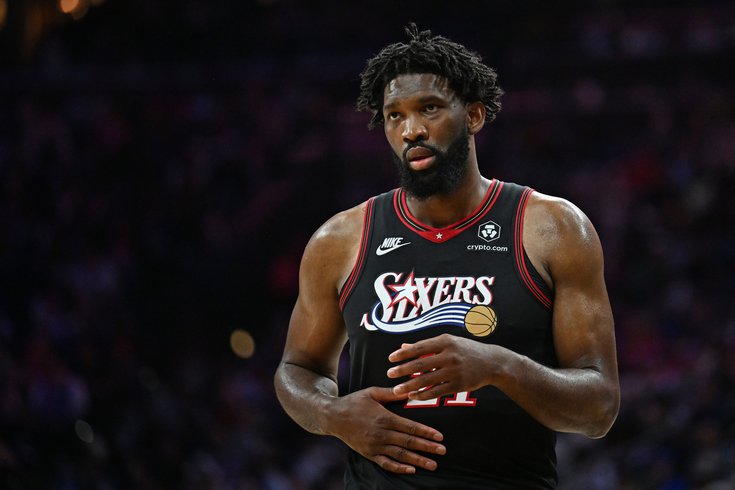 Eric Hartline/Imagn Images
Can Joel Embiid help the Sixers keep their season alive on Tuesday night in Boston?
PHILADELPHIA – Earlier this month, the Sixers changed their postgame media availability protocol. Instead of standout performers from each game speaking at their lockers after home games, they would instead speak in front of a giant screen in the back of the locker room usually used for film cuts that players can watch as they shuffle in and out before a game.
On the day the new arrangement made its debut, Joel Embiid stood in front of a blank screen and called out Sixers President of Basketball Operations Daryl Morey, alleging he found out about being ruled out for a game a few days prior online and expressing frustration with management.
As it turned out, Embiid would not stand in front of that screen and speak to reporters again for a while. More than three weeks, four Sixers postseason games, one appendectomy and a shockingly quick return to the floor later, Embiid spoke to reporters after the Sixers went down 3-1 in their first-round series against the Boston Celtics on Sunday night.
In this week's 5 Sixers thoughts, the most relevant quotes from Embiid's 11-minute media availability after the Sixers' Game 4 loss, from discovering his appendicitis to the state of the series he just joined, and his current relationship with Morey:
Embiid has had as challenging of a 17-day period as could be imagined. Sleepless nights caused by stomach pain he could not figure out the cause of led to him being largely immobilized, visiting the hospital and eventually undergoing his emergency appendectomy. And in 17 days since, he recovered, began a strength and conditioning program, ramped up with on-court work and then returned by playing 34 minutes in a playoff game.
What were those 17 days in between surgery and returning like?
"A lot. I mean, when this first started, I couldn't walk even getting to the hospital. And yeah, just dealing with some other stuff that came from it, just adjusting and did include that. And yeah, I don't want to get into the details, but it's been tough, but you got to – that's life. Even when it happens, you look at it, you're like, 'Okay, playoffs are here.' You feel pretty good going into the playoffs and all of a sudden this thing happens. Some things you can't control. What am I going to do, cry about it? No. Just take it on and move on and do the best job possible to give yourself the best chance to come back and play."
Embiid said he got up and down the floor one time and expressed surprise that he could log as many minutes as he did. Later on, he was asked about how scary the experience was. He went into tremendous detail about what he felt in the days leading up to his diagnosis and surgery:
"Well, it first started in San Antonio. Stomach started hurting and I thought I never had stomach pain before, but I thought I ate something bad. They had me try some food from Texas. So I thought it was, I guess, a stomach virus or something. So I started feeling it right during the game and then that same night. And then the next day we had practice, go through practice and [I had a] good conversation with the team. So I felt like it was pretty bad, but I was going to take it easy during practice because it was pretty bad. But we had a good conversation with the team about what we needed to do, so I kind of wanted to send a message and go out there and practice really hard. And by the time I got back to the hotel, yeah, it just kept getting worse and worse and worse. And at night, that same night before the game, I tried to – I didn't want to bother [the medical staff] because they were sleeping, but you got to the point where I couldn't sleep and I was just up until, like, four in the morning. I was like, 'Yeah, I need help.' And you go to the bathroom, you can't poop, nothing was coming up, you can't even walk. So that's why I had to tell them. I'm like, 'Something is very wrong here.' I don't like the hospital and all those MRIs and CT scans, but it got to a point where it was really bad where [I had to go]. I don't know what a stomach virus is supposed to feel like, but yeah, something else is going on. And then that's when we had to go to the hospital and that's when we found out that was going on."
The very first thing that Embiid said on Sunday: he experienced complications after his appendectomy on April 9 in Houston. This was his response when asked about the toughest part of working his way into a series after three games had already gone by:
"It was tough because I had some complications after the surgery, still kind of dealing with them. And obviously I went up and down once. I need to get the chance to play once and go right back. It's tough. But you try to do the best job possible with the conditions. Still got to go out there and try to play well and win a basketball game and we didn't do that tonight. We didn't play well."
What were those complications and how are they impacting him now?
"Don't want to get into the details, but obviously it burst a little bit, so I'm sure you can find out online and some other stuff, but yeah, I think I'm just happy," Embiid said. "Obviously bummed about a loss. I felt like we had a pretty good chance, especially the way we started, but then again, me, everybody else not being able to make shots and then obviously them hitting every single three. Yeah, that's not a good combination."
The Sixers, for whatever it is worth, provided a medical update after Embiid's appendectomy which said it was a successful surgery. Embiid getting back on the floor after only 17 days already seemed remarkable in itself.
MORE: An early look at Sixers' options with No. 22 overall pick
So much of the last 17 days have been about hypothesizing when Embiid could return, marveling at his rapid progress and commending his toughness. Not as much of it was spent actually thinking about how he would change the tenor of a series that, for the Sixers, had been defined by two up-tempo guards taking as many shots as they could.
On Sunday, the Sixers played at a much slower pace, accommodating Embiid. Tyrese Maxey only took three shots in a lackluster first half; all parties involved lamented that fact afterwards. Embiid did not want to describe integrating back into what the team is doing as a challenge, but it is evident that toggling back and forth between opposite styles and approaches is difficult for this team to pull off.
Now that Embiid is officially a part of this series, what does he envision the Sixers needing to do to overcome a 3-1 deficit?
"We know what we didn't do well, obviously. I think they believe in what they believe, which is shoot a lot of threes and they believe that can make enough of them to win every single game. Tonight, [their] offensive rebounding hurt us a little bit. A lot actually. I think threes equal long rebounds. I felt like we keep coming in. Instead, we should go towards our man and check them before even looking at the ball, and that's an adjustment. We've had that problem all season, so we've got to do a better job. So I think just going with the mentality of one at a time. Take care of some of the mistakes we made today. Obviously we've got to do a better job making shots. We didn't do that in Game 1 and then we came back in Game 2. So yeah, just take care of, like I said, offensive rebounding, not giving them second chance points, and threes, just try to contest it even more than we did tonight."
Before Game 4 tipped off, a whiteboard in the Sixers' locker room had three bullet points written down. The first: "Whatever it takes to rebound." The Sixers did not follow through on that point of emphasis; Boston bludgeoned them on the glass on both ends of the floor all night. That led to open three-point shots, which the Sixers cannot allow to a team with so many high-caliber marksmen.
Everyone is familiar with Embiid's infamous rolodex of untimely – and often bizarre – injuries. And each time, he asked some version of the same question.
How does he not feel bad for himself and put his best foot forward in his recovery?
"When you've been through so much, you think you got to have the balance of, okay, this is another thing, got to move on, but it hurts and then it feels like it's every single time. It sucks, but you probably go through a couple days where you feel bad for yourself and it's right back to it. Are you going to give up or are you going to try to come back as early as possible? So yeah, I think it sucks, but you can't give up. You've got to keep pushing and not feel bad for yourself and just try to do the best job possible."
For those not up to date, a list of ailments that have plagued Embiid during his checkered history in the playoffs: he suffered an orbital fracture that delayed his first postseason run, the next year dealt with a knee issue and a reoccurring illness, two years later played with a torn meniscus, the following year had another orbital fracture in addition to tearing a ligament in his thumb, the next two seasons played through significant knee issues and in one of those years also played while dealing with a case of Bell's palsy. Now, Embiid is trying to will the Sixers into competing with the Eastern Conference's best two weeks and change after an appendectomy.
Everyone is entitled to have an opinion on Embiid, and he has provided plenty of material that his doubters believe justify not believing in him – particularly over the last two seasons. But for a player whose lack of availability is often attributed to a lack of desire to be on the floor, Embiid has once again gone out of his way to play on the game's biggest stage with an injury that will make him a shell of his best possible self.
MORE: Matt Cord reflects on 28-year run as Sixers' PA announcer
Circling back to Embiid's first appearance in front of that blank screen, his last time speaking to reporters in Philadelphia sparked plenty of speculation about the viability of his relationship with Morey.
After a few weeks and a frightening medical episode – plus the Sixers adding a virtual backdrop to that screen – where do things stand with Embiid and management? His answer to that was about two minutes long, but it did not address the question much:
"We're in the playoffs. We're down 3-1. So that's what we're focused on. I think we tried to do the best job possible to try to make sure that I get back on the court, but the focus is on the playoffs, trying to find a way to win one at a time. Down 3-1, it has been done before. Going out in Boston is going to be tough, but that's a really good team. So we know what they do well and we know some of the mistakes we made tonight, so now it's on us to try to figure it out, how to fix them and go out there and everything on the line play the best basketball possible because you either win or you have a couple months to think about, it wasn't a horrible season, but could have been better. So it's all about taking one game at a time and trying to win one, come back to Philadelphia, same mentality and we've won one game. Got to make shots, starts with me. So starts there and then kind of take them out of what they do well, which is driving, kick out, bunch of threes, offensive rebounding, physicality, I mean I was watching, I felt like tonight we weren't as physical as we've been the first couple games of the series. So we just got to go back to that mentality."
In all fairness, Embiid re-litigating his issues with Morey in the midst of a playoff series would be wholly unwise. It would also take the attention away from what he has accomplished by getting back on the floor in such short order. But the optics of answers have rarely mattered to Embiid.
The last time Embiid spoke in Philly, he was annoyed at Morey for not letting him play against the Wizards.
— PHLY Sixers (@PHLY_Sixers) April 27, 2026
Today, he was asked about his relationship with management. Instead of answering, he spent 2 minutes talking about the keys to getting back in the series against Boston. pic.twitter.com/zeKF4NT7Kp
Embiid's health situation – well before his case of appendicitis – was so unique that it requires a particularly trusting relationship between the player and the team's primary decision-makers. If the Sixers ever find a suitable arrangement for Embiid's management that keeps him healthy and available consistently, it will be because of a collaborative effort. It is imperative Embiid is on the same page with Morey moving forward if this situation is going to be turned around.
MORE: Embiid calls out Morey earlier this month