





September 24, 2026
 Courtenay Harris Bond/PhillyVoice
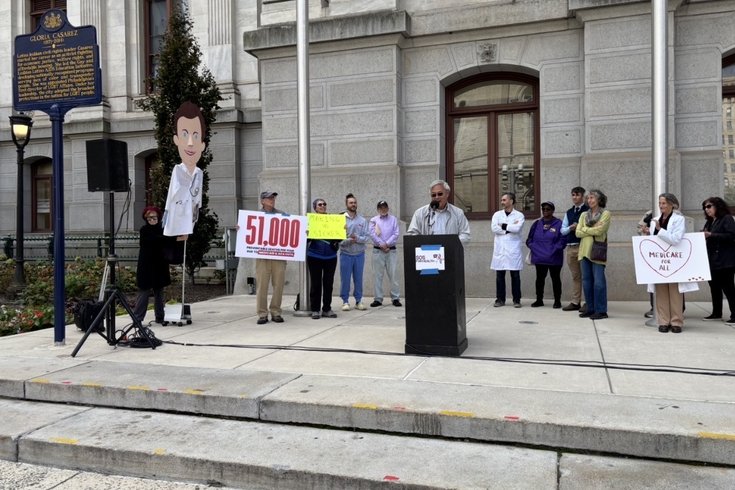
Former Philadelphia Health Commissioner Walter Tsou and other health workers protest federal healthcare policy changes outside City Hall on Thursday.
A group of healthcare workers gathered outside City Hall on Thursday to speak out against healthcare cuts and policy changes under the Trump administration.
The rally in Philadelphia was one of about 30 being held nationwide over the next several days, said Brittany Shannahan, one of the rally's national organizers. Others are slated for the Centers for Disease Control and Prevention headquarters in Atlanta and at the National Institutes of Health headquarters in Bethesda, Maryland. The push, dubbed "SOS for Health," was organized by the American Public Health Association, a national public health advocacy group.
MORE: GLP-1 drugmakers are being sued by patients who suddenly lost their vision
"Health and public health workers are coming out across the country to take a stand on this giant agenda of cuts," Shannahan said.
Enrollment in public health plans through the Affordable Care Act marketplace have dropped by at least 3 million people since the expiration of tax credits that helped people get coverage. The decline in enrollment in 2026 – the first drop in seven years, according to KFF – is likely due to the rise in the cost of insurance premiums since the end of the tax credits.
The Department of Health and Human Services has said the drop from about 22 million Obamacare enrollees in 2025 to about 19 million in 2026 is partly due to a crackdown on fraudulent enrollment. On Wednesday, Trump administration officials announced they would remove close to 800,000 people from health care exchange plans, because they were enrolled through fraud or did not exist.
Hospitals are reporting a spike in uninsured patients, threatening the viability of health systems across the country.
The One Big Beautiful Bill Act, which President Donald Trump signed into law in 2025, aims to cut spending on Medicaid by roughly $1 trillion over eight years. It does not account for how much it will cost states to enforce the new rules, potentially leading to the loss of insurance for residents, according to KFF.
The new Medicaid regulations are set to take effect Jan. 1, increasing work requirements, among other changes, to the federal program that provides free and low-cost health coverage for people with limited resources.
"If you think about the fact that St. Christopher's (Hospital for Children) probably has 80% of their patients on Medicaid and Temple (Health) probably about 40% — we're talking about some of the pillars of health care in this city who are going to be impacted by these cuts," Dr. Walter Tsou, former Philadelphia health commissioner, said at Thursday's rally.
Dr. David Oxman, an intensive care physician at Jefferson Health, said he was there to draw attention to the "devastation that these cuts are going to wreak in cities and states and across the country."
"If you come into my ICU, I don't care what insurance you have," Oxman said. "I do what needs to be done."
But the cuts are leading to more uninsured patients and more unreimbursed care that threatens the viability of health systems nationwide, Oxman said.
"This ship has always had a few leaks in it, but these cuts will make those leaks into massive holes," Oxman said, warning that "we are all going down in this ship together."