





April 27, 2026
 Michaela Althouse/PhillyVoice
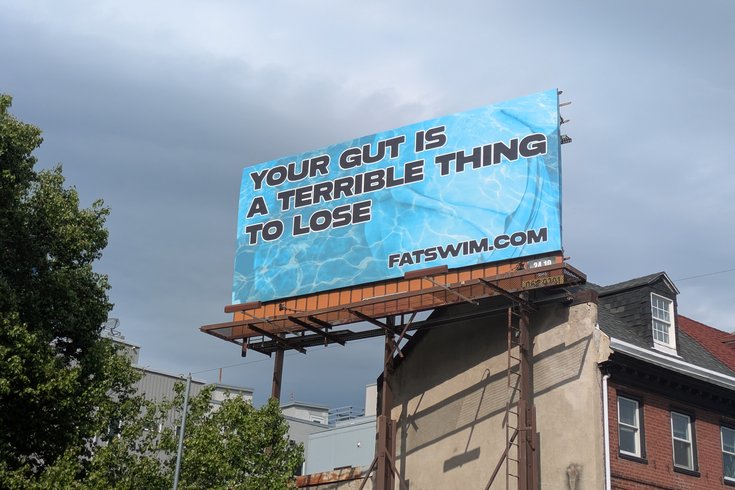
South Philly author Emma Copley Eisenberg has a billboard on I-95 that promotes the website for her new book 'Fat Swim.'
On her new billboard along Interstate-95 North, South Philly author Emma Copley Eisenberg said she chose the phrase "Your gut is a terrible thing to lose" as a play on words of the saying "Your mind is a terrible thing to waste."
"Everyone's always saying, 'trust your gut, trust your gut,' that's where your instincts and your wisdom live," Copley Eisenberg said. "But at the same time, there's all this pressure to lose it, so which is it? That contradiction started to feel really interesting to me, so I just hope it sparks conversation."
The display, up until May 25, also includes a photo from local artist Devon Dadoly of a body underwater. It was created with funds from a settlement Copley Eisenberg won after her first book, "The Third Rainbow Girl," was among thousands of published works used without permission by Anthropic to train AI chatbot Claude. She wanted to use the money to support local art and create something which could be viewed by anyone.
"I was like, 'What's the opposite of the algorithm?' and my one friend was like, 'Well, it would have to be something completely static that doesn't adapt based on the person viewing it, so it would have to be offline,'" Copley Eisenberg said. "It just kind of hit me one day driving around, billboards are kind of the last publicly available way to communicate information or an image or message to the public."
The installation includes the website fatswim.com, which features resources on body autonomy, fat liberation and weight neutrality, as well as a link to Copley Eisenberg's new book, "Fat Swim," which is out Tuesday. The short story collection follows the success of her second book, "Housemates," which was released in 2024 and grew from a story originally meant to be in "Fat Swim."
The 10 stories center on different characters, but they're all set in the Philadelphia area. One follows a local preteen who learns about her changing body from a group of women at the local West Philly pool, another tells of a polyamorous bartender at Ray's "Happy Birthday" Bar in East Passyunk and another imagines a camp in Central Pennsylvania where people can go to "fix" their relationship with their bodies.
Copley Eisenberg said she's been working on the book on and off for more than a decade, and the narratives often overlap because she would write a story about one character and then start thinking more about how to explore some of the side characters. In that way, one tale would lead to the next.
"The book is a lot about not just fatness, like in the title, but really also about sex and sexuality and relationships and polyamory and what it means to like be a person with a sexuality and a gender," Copley Eisenberg said. "I just kept learning things, and the world kept changing and stories kept kind of organically being written in response to all those changes."
Water and swimming are also common themes, partially because she felt so inspired by how crucial water is to Philadelphia in the warm months. When it's so hot and sticky, she said the only way to survive is to seek water, be that the public pool or the Jersey Shore.
As readers move through the stories, Copley Eisenberg said she hopes they show that there's no right way for people to think about their bodies. Amid so much hate and shame that can be generated about fatness, especially with advertisements for weight-loss drugs and supplements, she said there's also a lot of simultaneous public pressure for people to love their shapes. But even people who advocate for body liberation and autonomy can have private feelings about their own bodies that are at odds with their public views, she said. She thinks that's a natural response and part of the journey.
"The only thing I hope people take away from 'Fat Swim' is just that sense that there is no answer and there is no right way to be," Copley Eisenberg said. "Wherever people are at, that's your process, and no one has the answer, least of all weight-loss corporations or people who are profiting off of our shame."