



November 18, 2026
 Greg Hilburn/USA TODAY NETWORK via Reuters Connect
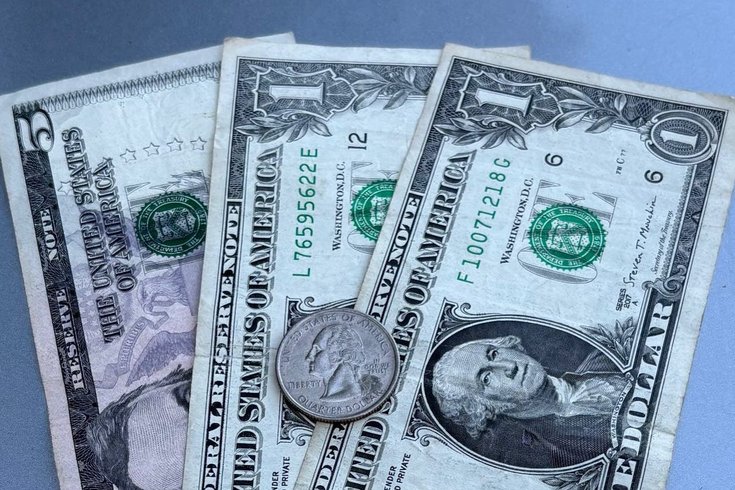
Pennsylvania Democrats have said raising the state's minimum wage, currently set at $7.25, will be a top priority next year.
In 2006, state Sens. Vincent Hughes and Christine Tartaglione stood beside Gov. Ed Rendell when he signed a bill to raise Pennsylvania's minimum wage to $7.15.
At the time, it was $2 above the federal requirement and higher than the rate in New York, New Jersey, Delaware, Maryland, Ohio and West Virginia, said Hughes (D-7th). In 2009, it got another slight bump, when President Barack Obama raised the national minimum to $7.25. But that's where Pennsylvania has remained ever since, while all of the surrounding states have raised their rates: New York is at $16, New Jersey is at $15.92, Delaware is $15 and Ohio is $11, with some states having additional increases set for 2027.
"We were higher, and then every state around us surpassed us, and that is not just an economic frustration, but that's a personal frustration as well," Hughes said.
Hughes has been a leader in the efforts to raise the state's minimum wage for years, but while the legislation has passed through the state House a few times, measures have been either voted down or never made it to the floor in the Republican-controlled state Senate. However, after Democrats regained control of both legislative chambers and the governor's mansion for the first time since 1993, raising minimum wage now seems possible — and is top priority for many lawmakers.
The day after the midterm elections, Gov. Josh Shapiro (D) made a social media post making his plans for the new year abundantly clear.
"The very first bill that I will sign into law with our new Democratic majority this January will be to raise our minimum wage — and make sure every Pennsylvania worker has a livable wage," Shapiro wrote. "It's long overdue."
Shapiro reiterated his position Tuesday, posting that a $15 minimum wage "will be a reality in Pennsylvania." Hughes, too, confirmed that the plan for a minimum wage increase is "to get it done and get it done quickly," and that one of the fundamental goals is to raise it to $15 as quickly as possible, "if not automatically."
"People need to understand that, let's say we make it immediate, that is doubling of someone's income automatically," Hughes said. "Think about how you would feel if your income was doubled, you'd feel very nice."
While it appears that a raise is inevitable, it's unclear just how high lawmakers will go and how fast the adjustment will go into effect. Jeff Hornstein, the executive director of the Economy League of Greater Philadelphia, a nonpartisan think tank, expects that wages will grow incrementally over five years to allow businesses time to adjust.
Still, some lawmakers think $15 isn't a big enough change. State Sen.-elect Mark Pinsley (D-16th) has already said he plans to fight for a $25 minimum wage, WFMZ reported. Hornstein said to be self-sufficient and live in Philadelphia, residents need to be making about that much, and he noted that the push for a $15 pay floor began more than a decade ago and doesn't account for inflation.
"If you don't earn $25 an hour as an individual in a city like Philadelphia, it's very hard to afford rent, it's very hard to afford food, it's very hard to afford utilities," Hornstein said. "So $15 is good, it's going to push some people up, but the $15 minimum wage, that campaign started as I was leaving the labor movement in 2010. So we're 15 years past that."
On the other side, some lawmakers say they want a smaller increase, or none at all. Pinsley's predecessor Jarrett Coleman (R) told WFMZ that small business owners in the Lehigh Valley will be forced to cut jobs and raise prices if minimum wage goes up to $15 per hour. During the vote for the state budget in July, state Sen. Joe Pittman (R-41st) said Democratic senators were refusing to meet in the middle.
"The reality is that this commonwealth is very diverse," Pittman, who's from western Pennsylvania, told the Pennsylvania Capital-Star. "Cost of living changes from region to region, labor costs change from region to region. I can tell you that I've heard particularly from nonprofits in the district I represent the challenges that a $15 an hour minimum wage would impose."
Another criticism has been that upping the minimum wage would only impact a small amount of workers. Per state data, approximately 42,900 people earned minimum wage or less in 2025, which is down 9.1% from the previous year and only a fraction of the roughly 6.6 million people in the labor force.
Tartaglione (D-2nd), who negotiated the raise to $7.15 in 2006, has introduced a minimum wage bill every session for 32 years. Her latest called for a gradual increase to $15 by 2029 and annual cost-of-living increases beginning in 2030. After her latest effort failed to make it to a Senate vote, she addressed the idea that the impact of a bump would be small.
"My comeback is, 'Well, tell that to my single mother who's working three jobs because she needs to pay rent, she needs to put food on the table,'" she told the Capital-Star. "How about the people that sweep the streets? How about the people that serve you the food when you go somewhere? They're all making $7.25 an hour. And we're telling them they're not important."
For Philadelphia residents, a statewide change would make a difference. While many local politicians have expressed support for higher wages, the city isn't allowed to set its own rate due to Pennsylvania's Minimum Wage Act. (However, it has set a rule that any job driven by city funds must pay 1 1/2 times the $7.25 rate, and people hired for city projects must make at least $10.88 per hour).
Hourly workers in Philadelphia often fall under three major industries: education, medicine and hospitality. But the latter group, which includes hotel and restaurant employees, are "among the least organized," according to Hornstein, meaning they don't have unions fighting for pay raises. It's unclear how the increase will impact tipped workers like servers, whose current cash wage is $2.83 per hour, but Hornstein believes it could be a positive change for hourly workers and the local economy.
"If it pushes up the bottom, that's good. There'll be more more wage taxes being paid, more sales tax being paid, people will have more money to spend" Hornstein said. "More neighborhood businesses will hopefully grow, there'll be more money circulating in neighborhoods. Those are all good things."
Although, Hornstein said the added costs could get passed onto consumers — a grocery store, for example, might have to raise prices to offset the higher wages for employees. But since he thinks the biggest impact will be in sectors like hospitality, which are non-essentials, he doesn't "find that argument terribly compelling."
He also noted that a bigger pressure on small businesses right now is actually offsetting costs from inflation and the supply chain, which have led to higher prices for restaurant ingredients, imported goods and more.
"If you're in a sector where there's a lot of low-wage workers and those minimum wages get pushed up from the bottom, you may have to pay a little more to keep good employees," Hornstein said. "But without good employees, you can't run your business anyway, so there are certain things you have control over and certain things you don't. Right now, there's way too many things that are out of control of small businesses to allow them to make really good, predictable decisions."