




October 19, 2026
 Bill Streicher/IMAGN IMAGES via Reuters Connect
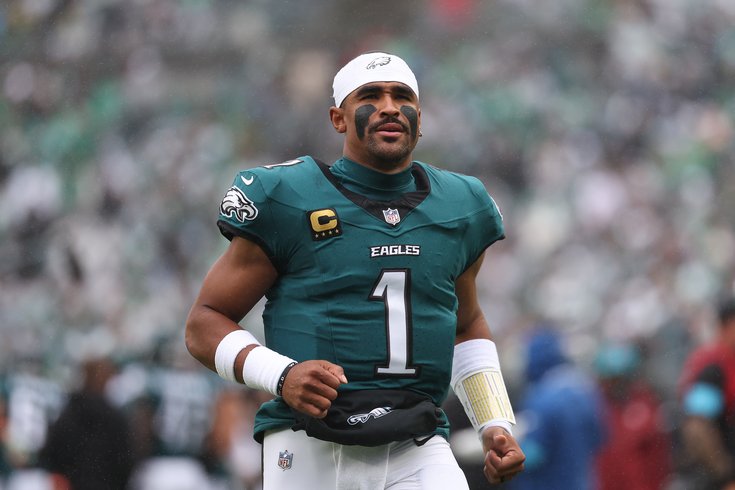
Jalen Hurts has a long road ahead of him.
Jalen Hurts' season is over.
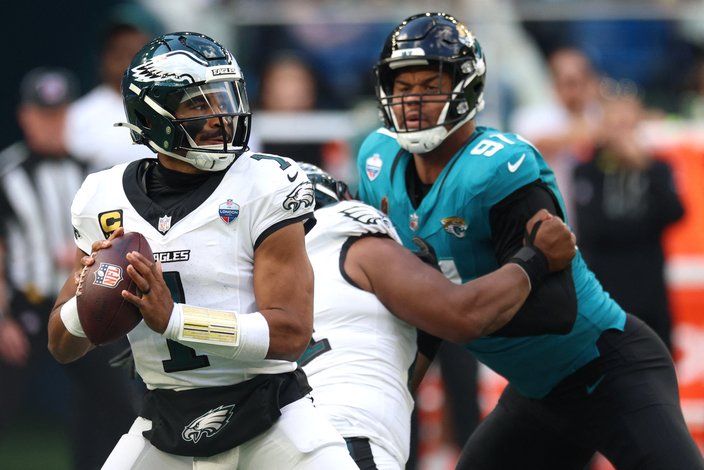
What was initially diagnosed as a superficial blood clot in his calf, which he was deemed safe to play with for the Eagles' Week 5 game against the Jacksonville Jaguars in London, has been re-diagnosed as "deep vein thrombosis, as well as bilateral pulmonary emboli," per a joint statement released Monday by the Eagles and Hurts' agent Nicole Lynn.
"He is clinically stable and has no significant functional limitations," the statement read. "His treatment should only involve anticoagulation (i.e. "blood thinners"). During this time, he will not be allowed to participate in any contact activities, including football.
"Jalen's prognosis is very good, and we expect a full recovery. We anticipate that he will have the opportunity to resume contact football activities when off the blood thinners. In the meantime, he will remain active around the team and continue to condition. More importantly, we anticipate that he will have no long-term effects."
But, of course, news as major as the starting quarterback for the Philadelphia Eagles going out for the season couldn't be left there. As soon as the statement was posted to social media, rumors, reports, and speculation as to what could've happened followed, along with worry, anger, and a hunt for a source of blame from a fan base that won't see its star quarterback until (likely) next season, while seeing this current one continue to go down the drain.
The week ahead will surely bring more information to come, but for now, here's a rundown of how a superficial blood clot in the calf can develop into deep vein thrombosis and bilateral pulmonary emboli, as explained by Dr. Parth M. Rali, MD – Professor, Thoracic Medicine and Surgery, Lewis Katz School of Medicine at Temple University.
Before getting started, an important disclosure: The views and opinions expressed in this article are those of the author and guest authors and do not reflect any official policy or position of any NFL team or a team's athletic physicians.
To set the stage, Dr. Rali likened blood flow in the legs to roads and highways going up to the heart and lungs and back.
Superficial veins are closer to the skin, and are like local roads.
Deep veins run deep inside the muscles, and eventually merge together into one big vein going toward the heart, like a highway.
"So it's almost like you think about it as a local road merging into a major interstate highway," Dr. Rali said. "Your superficial veins are local roads, and your deep veins are your major interstate highways."
The starting point, as it relates to Hurts, begins on Oct. 8 with his calf, when he sought treatment for it after getting cleated on the leg during the Oct. 4 loss to the Rams at Lincoln Financial Field, per an earlier statement released by the Eagles.
He continued to practice, made the team's flight to London later that week, then an ultrasound was performed that Saturday, before the Eagles played the Jaguars, which caught the superficial blood clot.
Hurts still played and made the flight home, but then on Thursday, when the original statement was released, a follow-up ultrasound from the night before detected movement of the clot, which ruled Hurts out for this past Sunday's Panthers game.
"Injury leads to inflammation," Dr. Rali said. "Inflammation can lead to altered mechanism in the body where you can form a blood clot, and beyond form the blood clot, right? Think about when you get a cut, and then you form a blood clot. Eventually, it heals.
"So really, because of the calf injury, Jalen must have formed what was initially described as a superficial vein thrombosis, right?
"A lot of times, superficial vein thrombosis, we don't need to treat it. We can watch it, which is I think what happened in his case"
But it's not something to be ignored, Dr. Rali continued, because cases can develop into something else – like the clot moving, or getting bigger, or getting closer to a deep vein, which would then consist of treatments like getting a patient on blood thinners for about six weeks.
Hurts, as we know now, went in that direction, which was further reinforced by his placement on injured reserve this past Saturday.
"And I think what we learned today is that clot had traveled into the deep veins like a major interstate highway," Dr Rali said. "From there, they go to the heart, and from the heart, they will go into the lung vessels, which we call pulmonary arteries.
"Pulmonary arteries are like a branch of tree. You have a big stem at the base, and then it divides and divides and divides, so the clot will divide and divide and divide."
Which brings Hurts and the Eagles to the quarterback's current situation and diagnosis.
Jalen Hurts played against the Jaguars in London, even though the Eagles already knew he had a blood clot in his calf.
It's not uncommon for a superficial blood clot to escalate into a deep vein one, especially from the legs, and compounding circumstances like a nonstop NFL schedule that included flights to and from London likely didn't help.
Blood clots aren't exactly uncommon diagnoses in professional sports either. Tennis great Serena Williams has dealt with them in the past, so have a number of NHL players like former Flyers defenseman Kimmo Timonen, and even last year, star Phillies pitcher Zack Wheeler had to be shut down after the discovery of a blood clot in his shoulder, which was followed by procedures to remove it and to address venous thoracic outlet syndrome.
Williams returned to the court, so did Timonen (though in a limited capacity at the end of his career), and Wheeler made it back to the mound partway through this past Phillies season, pitching mostly like his usual self.
That's not to dismiss the seriousness of the situation. If anything, it's to acknowledge that blood clots can happen to anyone, and the symptoms, if they arise, shouldn't be ignored,
It's also to point out that Hurts faces a long road ahead of him, just by the nature of his job as a starting quarterback in the NFL.
He'll be on blood thinners now, per Monday's joint statement, and won't be doing any football activity that puts him at risk of contact and until he is well off of them and cleared.
"This is a time where we need to have Jalen's body rest and recover from the blood clot," Dr. Rali said.
"Your body will resolve the clots on its own and the blood thinners will prevent a blood clot from forming," Dr Rali continued. "But while you're on the blood thinners, you cannot be involved in any form of contact sports, because if you get an inadvertent, unanticipated injury, you can bleed at the sites, which could be critical and life-threatening also."
So he needs time, and the assurance from his doctors that his heart isn't under any strain, that the clots are dissolved, and that he can, eventually, be taken off the blood thinners.
Only then will Hurts be able to get back into a full exercise routine, then slowly progress back into practice with the Eagles.
But again, it's going to be a while, and a matter that needs to be approached with great caution.
SIGN UP HERE to receive the PhillyVoice Sports newsletter
Follow Nick on Twitter: @itssnick
Follow Nick on Bluesky: @itssnick
Like us on Facebook: PhillyVoice Sports